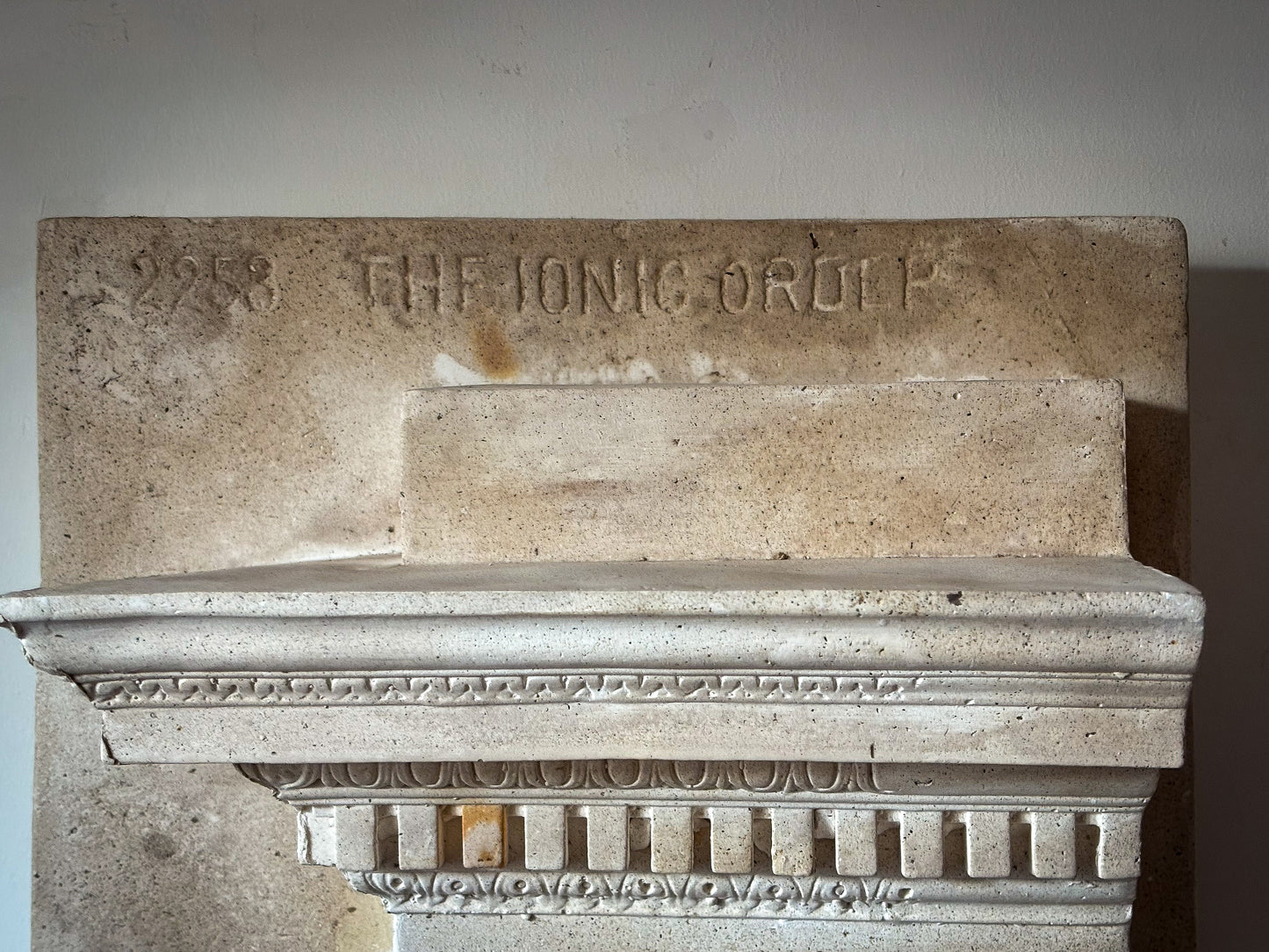
After D. Brucciani & Co., London The Classical Orders: Tuscan, Ionic, Corinthian and Composite
Couldn't load pickup availability
British, early 20th century
Plaster relief panels, each inscribed with the title of the order and bearing the moulded legend D. BRUCCIANI & Co. LONDON
Each approx. 56 × 38 cm
A rare near-complete suite of architectural teaching casts illustrating the progression of the Classical Orders, conceived as wall panels for the training of architects and draughtsmen. Each relief isolates a section of column and entablature, the profile projecting sharply from a flat backboard so that the proportions of base, shaft, capital and cornice can be read at a glance.
The sequence moves from the Tuscan Order, with its unfluted shaft and restrained mouldings, through the Ionic Order with its scrolling volutes and dentilled cornice, to the richly articulated Corinthian and the opulent Composite, where Ionic volutes are fused with a luxuriant acanthus capital. The titles – THE TUSCAN ORDER, THE IONIC ORDER, THE CORINTHIAN ORDER and THE COMPOSITE ORDER – are incised across the upper frieze in the manner of 19th-century pattern books.
These casts are taken from models associated with D. Brucciani & Co. of London, the celebrated suppliers of plaster casts to the South Kensington Museum and to Schools of Art across Britain. Brucciani’s workshop standardised sets of capitals, orders and entablatures that became a visual grammar for Victorian design education. The present examples, with their warm, stone-like patina, scattered studio accretions and small losses, belong to that teaching tradition: later impressions taken from Brucciani-derived moulds, used and handled in an academic setting and now carrying all the surface history that designers and decorators look for.
Hung as a grid, the four panels form an unusually sculptural essay on the Classical Orders, somewhere between drawing, model and fragment of façade and sit comfortably in the conversation between historic architecture and contemporary interiors.