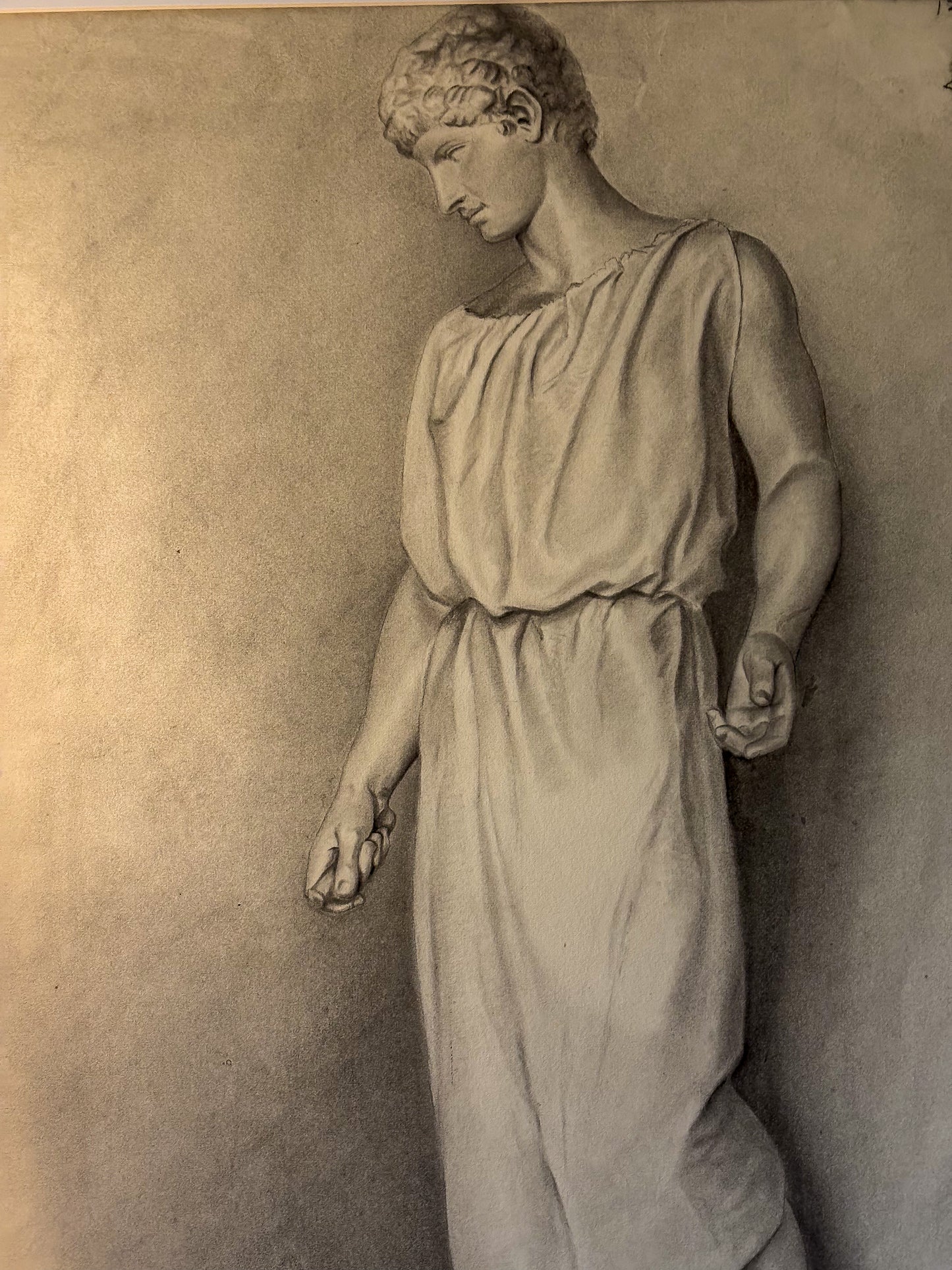
Cast drawing after the Capitoline Antinous
Couldn't load pickup availability
Unidentified female student of the National Art Training School, South Kensington
Charcoal and graphite on paper, with E.S.K. blind stamp
Dated in pencil on the verso “Janry 22” and “Febry 1 1889”
78 x 53 cm - unframed
This large, meticulously finished sheet is an examination drawing made under the South Kensington system at the National Art Training School on the site of today’s Victoria and Albert Museum and Royal College of Art. Worked in charcoal and graphite over a finely prepared surface, it records a full-length plaster cast of the Capitoline Antinous, here in the prudently draped variant supplied to Victorian art schools. The idealised head with its heavy curls, the downward, introspective tilt of the face and the delicately balanced contrapposto all follow the celebrated Roman marble, while the high-girdled tunic and bare right arm translate the ancient nude into something acceptable to late-19th-century pedagogical taste.
The draughtswoman pursues an almost sculptural understanding of form. The modelling of the head and neck, the fall of folds across the chest and cinched waist, and the carefully weighted feet on the plinth are rendered through slow, disciplined gradations of tone rather than outline, in strict accordance with South Kensington teaching. Light gathers at the brow, collarbone and knuckles before dissolving into the soft penumbra of the background. Hands and feet – traditional tests of skill – are observed with particular care, the toes articulated one by one and the tension of the fingers registered against the stillness of the pose.
Near the base is the perforated E.S.K. blind stamp (“Examined South Kensington”), identifying the drawing as an officially assessed work produced under the South Kensington system. Pencil inscriptions – “Janry 22” and “Febry 1 1889” – record the dates of the examination sessions, allowing the sheet to be securely placed in the winter of 1889. According to later testimony, the drawing is by a Russian female artist who studied in London and subsequently settled in Paris, and it can plausibly be read as evidence of the cosmopolitan reach of the South Kensington schools, whose rigorous cast training underpinned the careers of many continental artists and designers.
The drawing remains in a fine state of preservation. The image is undisturbed, the surface bloom of the charcoal intact, and the paper retains its characteristic, slightly fibrous texture. As a rare, fully worked South Kensington exam drawing after one of antiquity’s most iconic statues, enriched by its association with a female artist moving between London, Russia and Paris, it is both an object of considerable aesthetic power and a vivid witness to the discipline, ambition and international aspirations of Victorian academic training.