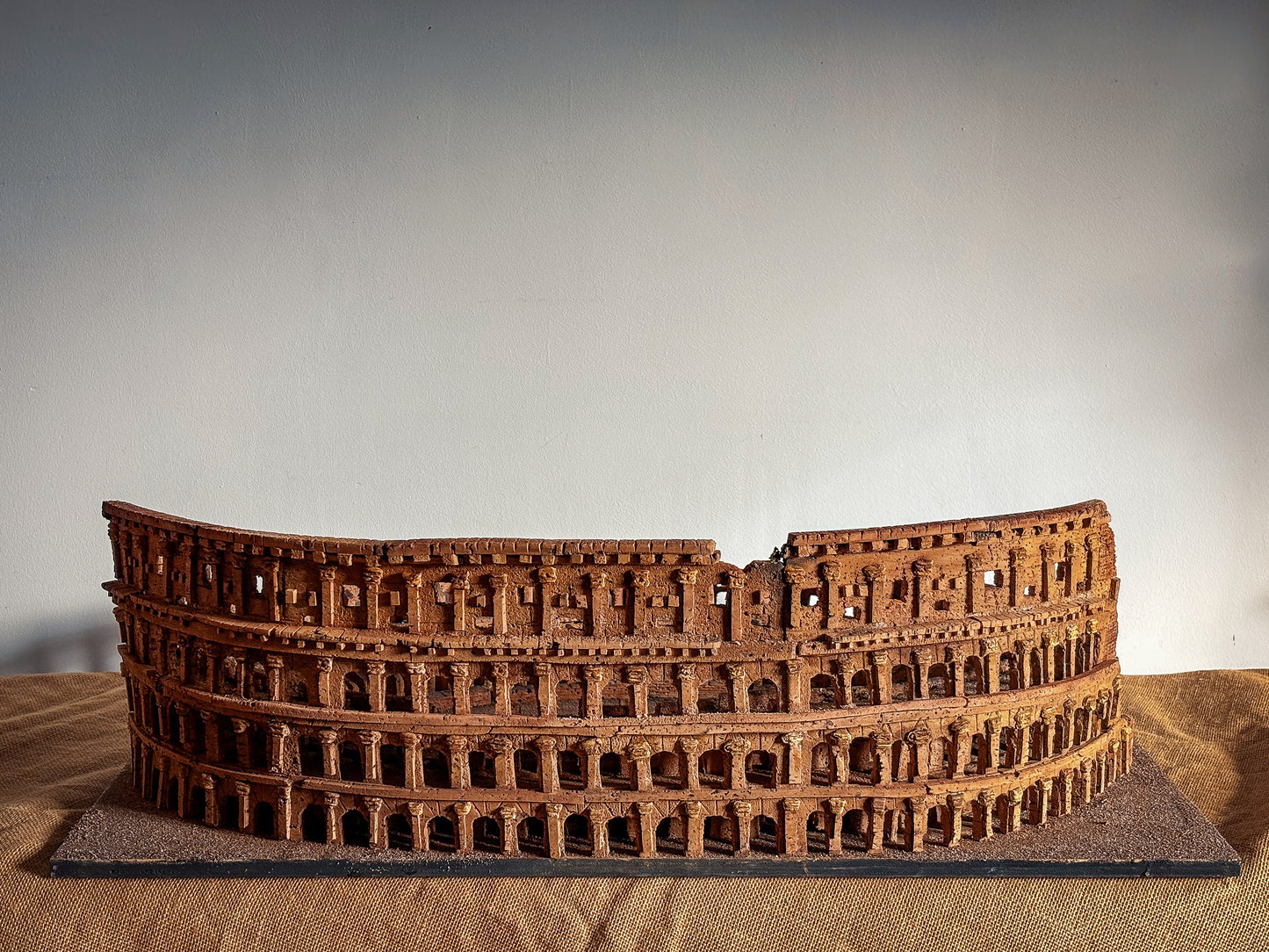
Cork Model of The Colosseum, Rome.
Couldn't load pickup availability
A contemporary reconstruction in the tradition of 18th- and early 19th-century Grand Tour cork modelling.
Cork architectural models formed one of the most distinctive artistic expressions of the Grand Tour. As Francis Haskell observed, they were prized because they united “instruction, antiquarian accuracy, and a poetic reading of ruin” in a single object.¹ Workshops in Rome and Naples, most notably those of Antonio Chichi, Agostino Rosa, and later Richard Du Bourg exploited cork’s granular structure to imitate with uncanny persuasiveness the eroded surfaces of ancient masonry.
This model of the Amphitheatrum Flavium follows the canonical Grand Tour presentation of the Colosseum:
not as a pristine reconstruction, nor as a didactic cut-away, but as the entire monument rendered in its ruined state, with the outer ellipse intact and the surviving northern sector shown at its authentic height. This approach mirrors how 18th-century travellers encountered the building, an immense, partially collapsed shell rising above a floor scattered with earth, debris, and vegetation, long before the major Papal stabilisation campaigns of the 19th century.
The surface treatments; graded cork dust, mineral grit, and warm sienna pigments recall the atmospheric character recorded in early engravings, including Piranesi’s celebrated views, in which the Colosseum appears as both archaeological subject and romantic emblem of antiquity.² Rather than attempting an idealised reconstruction, the model preserves the irregularity, asymmetry, and attrition that Grand Tour connoisseurs valued as the authentic imprint of time.
Original period cork models are now exceptionally scarce, following the dispersal and loss of major British and Continental collections.³ This reconstruction therefore operates both as homage and as a practical continuation of a nearly vanished craft—the sort of object that once signified a traveller’s architectural education and their familiarity with Rome’s most iconic
References
- Francis Haskell, Mechanisms of Taste, 1993.
- John Wilton-Ely, Piranesi as Architect and Designer, 1993.
- Richard Gillespie, “The Rise and Fall of Cork Model Collections in Britain,” Science Museum Group Journal, 2020.