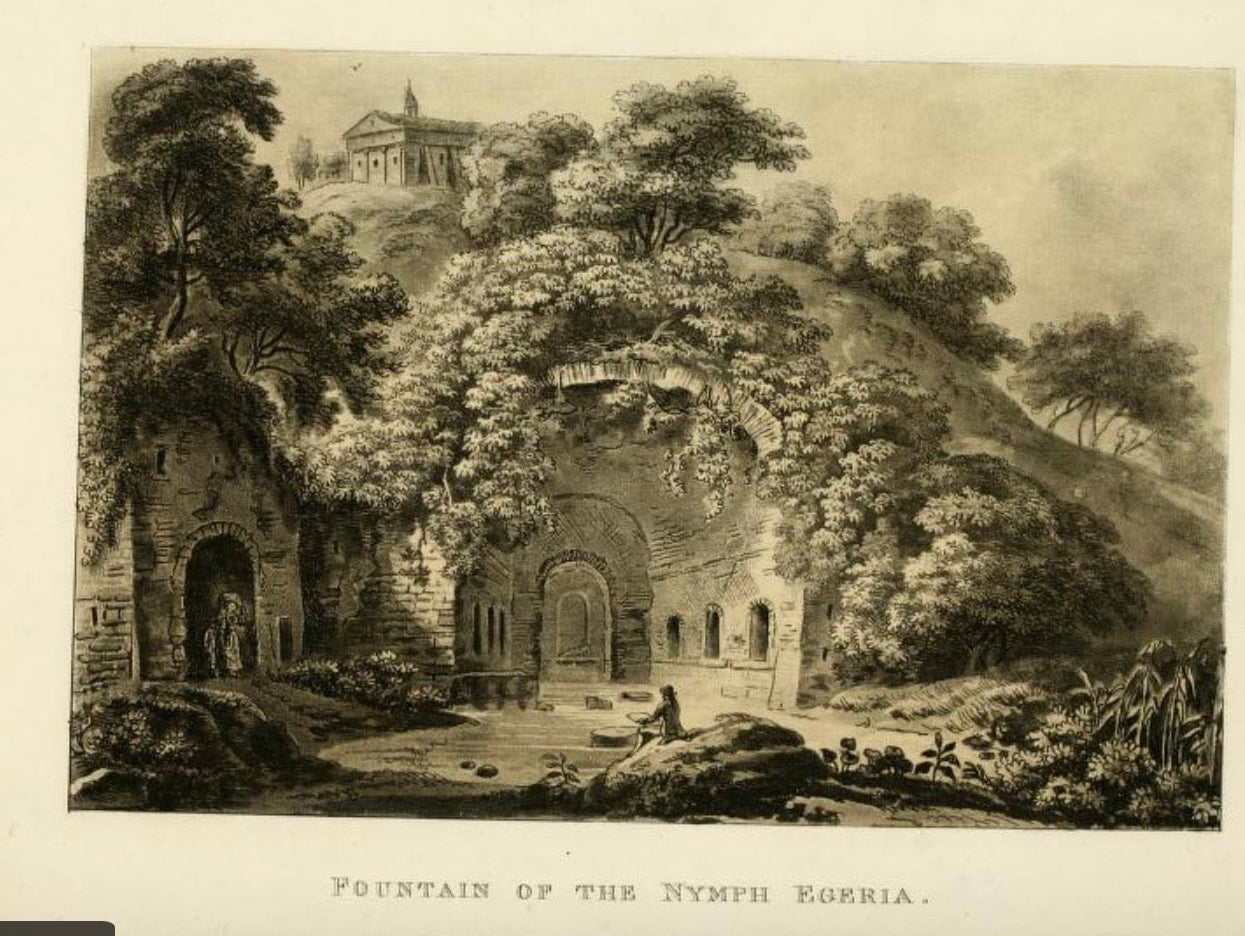
James Merigot (1760–1824) Temple of Concord, Rome; and Fountain of the Nymph Egeria, Rome
Couldn't load pickup availability
James Merigot (Jacques Merigot, 1760–1824)
Temple of Concord, Rome; and Fountain of the Nymph Egeria, Rome
Rome, c.1791
Pen, ink and wash on paper, laid on original embossed card, framed as a pair
A finely preserved pair of Grand Tour drawings of Rome by James Merigot, almost certainly the finished preparatory studies for two of his most famous aquatint plates, The Temple of Concord and Fountain of the Nymph Egeria, from A Select Collection of Views and Ruins in Rome and Its Vicinity. Recently Executed from Drawings Made Upon the Spot (London, 1796–98).
Both drawings share the same viewpoints and core arrangements as the published prints: the disposition of ruins, architecture, trees and staffage clearly shows them to be working studies for the plates made “upon the spot” in 1791 and subsequently referenced for use in the printmaking process, with additional details and refinements introduced at the engraving stage.
The upper drawing depicts the Temple of Concord in the Roman Forum: a classic Grand Tour view with the remaining Corinthian columns rising above scattered masonry, flanking ruins and distant palazzi. The lower sheet shows the romantic grotto of the Fountain of the Nymph Egeria on the Via Appia, its arched niche and ruined arcade half- engulfed by trees and undergrowth, with a small temple crowning the hill beyond. Both drawings are executed in delicate pen and ink with grey wash and mounted on their original embossed decorative cards, a charming, portable format aimed squarely at visiting travellers.
The sheets are titled on the reverse in a contemporary hand “Temple of Concord” and “Fountain of the Nymph Egeria” confirming the subjects and reinforcing their early Grand Tour origin.
Born in Paris as Jacques Merigot, the artist was the son of the publisher Jacques-François Mérigot. By 1790 he had followed his father into the trade and soon moved to London, where he worked as an engraver, draughtsman and publisher of romantic landscapes and views of the classical world. His Roman series A Select Collection of Views and Ruins in Rome and Its Vicinity is now represented in major museum collections; copies are held by the V&A and the Metropolitan Museum of Art, New York, where the work has been shown in Drawings and Prints: Selections from the Permanent Collection. The series is recorded in Abbey (Travel in Aquatint and Lithography, I, 159, no.178) and Brunet (II, 133, 1797 ed.).
The present pair, with their intimate scale, original mounts and soft, even patina, are a rare survival of Merigot’s preparatory material and encapsulate late-18th-century taste for antique ruins and picturesque decay