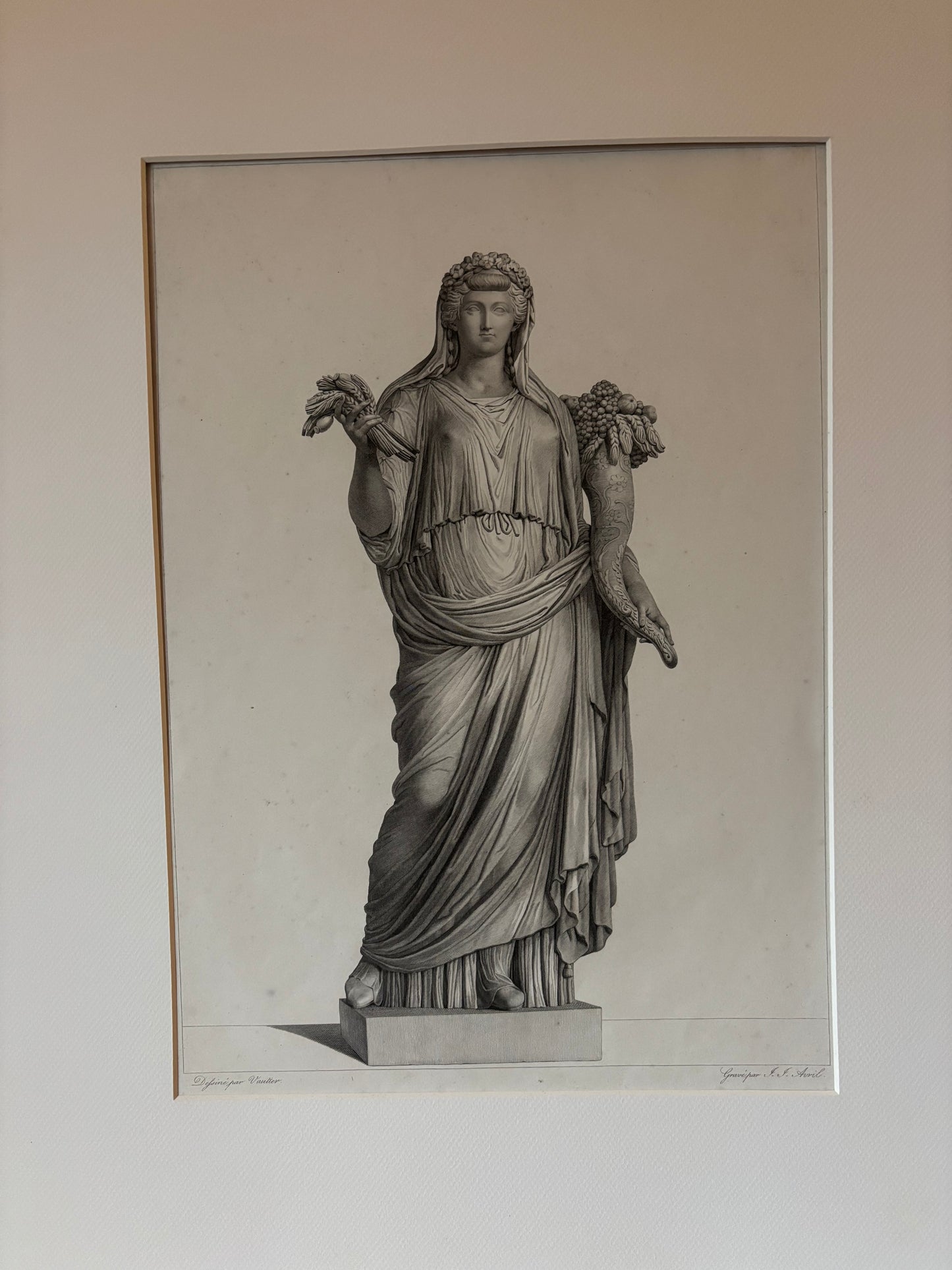
Livia as Ceres, after the Antique
Couldn't load pickup availability
Livia as Ceres, after the Antique
Drawn by Vautier; engraved by J.-J. Avril
French, early 19th century
Line engraving on laid paper
A finely executed neoclassical engraving after the celebrated Roman marble statue of Livia Drusilla (Julia Augusta) as the goddess Ceres, today in the Musée du Louvre, Paris. Veiled and crowned with a floral wreath, Livia stands full-length, holding a sheaf of corn in her right hand and a cornucopia overflowing with fruit and grapes in her left – the attributes of Ceres that proclaim imperial fertility, prosperity and the benevolence of the ruling house.
In Roman visual propaganda this pairing was anything but accidental. As the wife of Augustus and mother of Tiberius, Livia was presented as the ideal imperial matron: chaste, dignified and endlessly fertile, the guarantor of dynastic continuity. By dressing her as Ceres, goddess of grain and the yearly cycle of growth, sculptors and patrons linked the security of Rome’s food supply and the abundance of its harvests directly to the person of the empress. The ears of corn and brimming horn of plenty make Livia not just Augustus’ consort, but a divine protectress of the Roman people themselves.
The plate is signed in the lower margin “Dessiné par Vautier” and “Gravé par J. J. Avril”. Vautier here refers to the painter and draughtsman Jules-Antoine Vauthier (1774–1832), whose precise drawing supplied the model, while Jean-Jacques Avril (1744–1831) translates it into a wonderfully crisp line engraving. The modelling of the drapery, the cool, sculptural light and the careful rendering of the cornucopia all speak to the high quality of Parisian printmaking in the early 1800s and to the Grand Tour appetite for plates “after the Antique”.
A large, elegant sheet with good margins, showing light, even toning and scattered foxing consistent with age, but retaining excellent detail and a pleasing soft plate tone. Handsomely presented in a modern mount and ready to frame and hang – a quietly imposing image of one of Rome’s most powerful women, recast as a goddess of plenty.
Engraving itself: 15 × 10.5 inches ≈ 38.1 × 26.7 cm
Including mount: 24 × 19.5 inches ≈ 61.0 × 49.5 cm (